Getting around
Bearcat Transportation System
Free campus shuttle with 16 buses covering 13 routes connecting Uptown Campus to nearby neighborhoods and satellite campuses.
The student guide to Cincinnati, Ohio: where to eat, live and get help, what a year really costs, and the free stuff most students miss.
Source: U.S. Department of Education, College Scorecard.
After grants and scholarships, by family income. Average: $24,917.
Getting around
Free campus shuttle with 16 buses covering 13 routes connecting Uptown Campus to nearby neighborhoods and satellite campuses.
Places
Free food pantry and resource center in Stratford Heights providing groceries, personal care items, and support services to UC students experiencing…
Dining halls, quick bites and coffee on campus.

37,000 sq ft state-of-the-art dining facility between Calhoun and Siddall Halls featuring Foodiverse, a modern food hall concept with eight stations…
2580 Corbett Drive
Expansive all-you-care-to-eat facility in the Campus Recreation Center with over a dozen dining stations including pizza, Choolaah Indian cuisine…
2810 Woodside Drive
4-Star Certified Green Restaurant in Marian Spencer Hall with eight stations serving comfort food classics, made-to-order stir-fry and pasta…
2911 Scioto Lane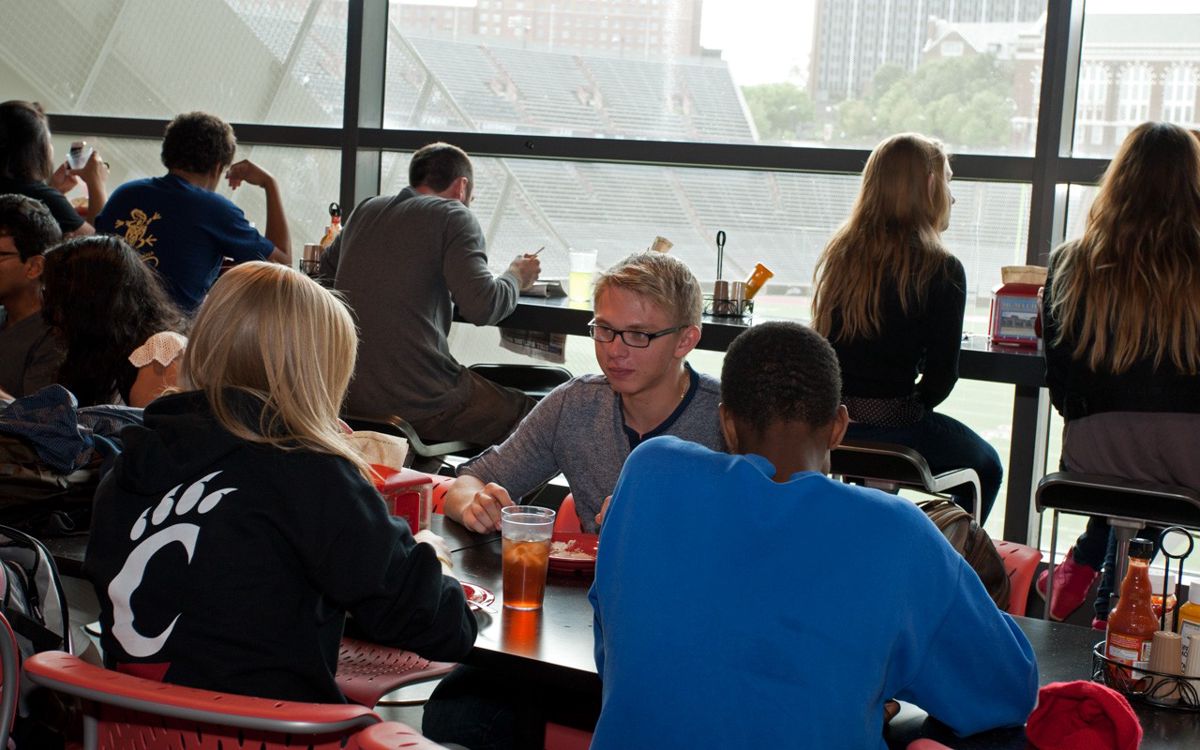
Casual dining spot at the Nippert Bridge Level of the Campus Recreation Center serving made-to-order rice bowls and customizable mac and cheese with…
2820 Bearcat Way
Hot buffet dining and grab-and-go options on TUC Level 3 featuring AC BBQ, BABB Breakfast Burritos, Bowl Lab, and Ibasho Sushi stations.
2766 UC MainStreetQuick-service chicken restaurant on TUC Level 2 Food Court serving signature chicken sandwiches, nuggets, and waffle fries.
2766 UC MainStreet
Bold, Asian-inspired dishes made with fresh ingredients and flavorful sauces on TUC Level 2 Food Court, a go-to spot for quick and satisfying meals.
2766 UC MainStreetMediterranean-inspired bowls and wraps on TUC Level 2 Food Court serving exclusively Halal meats with flavorful toppings and sauces.
2766 UC MainStreet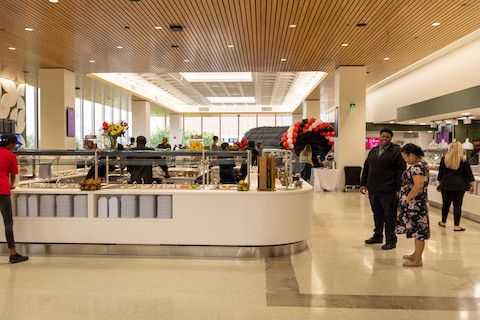
Rotating food vendor concept on TUC Level 2 serving a variety of grilled items and changing menus throughout the semester.
2766 UC MainStreet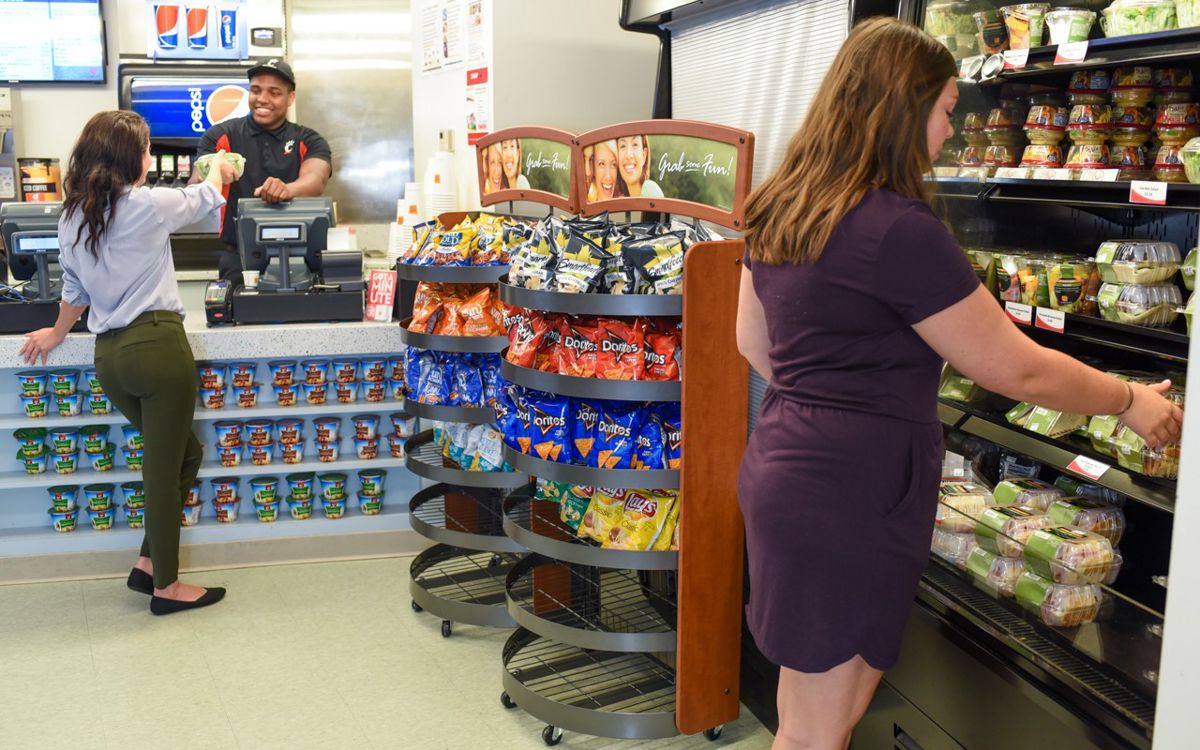
Cafe in the Aronoff Center atrium serving breakfast, lunch, and dinner options plus Simply to Go sandwiches, salads, iced bubble tea, and Rooted…
2624 Clifton AvenueSubway sandwich shop in the Steger Student Life Center offering fresh subs, wraps, and salads with meal plan swipe acceptance.
2766 UC MainStreetMini-grocery store in the Campus Recreation Center stocking water, dairy, snacks, grab-and-go meals, heat-and-eat options, and convenience essentials.
2820 Bearcat WayOne-stop convenience shop on TUC Level 3 offering snacks, grab-and-go meals, freshly brewed coffee, F'real smoothies, and everyday essentials.
2766 UC MainStreetFull-service Starbucks on the main floor of Langsam Library, the perfect study fuel stop with all your favorite espresso drinks and pastries.
2911 Woodside DriveStarbucks location on the main floor of the Lindner College of Business building, popular with business students between classes.
2906 Woodside DriveResidence halls, apartments and help finding a place.

Traditional-style residence hall with dramatic views of downtown Cincinnati and Nippert Stadium. Popular with first-year students.
240 Calhoun Street
Suite-style residence halls near Campus Green with shared bathrooms between two rooms. Active living-learning communities.
45 West University Avenue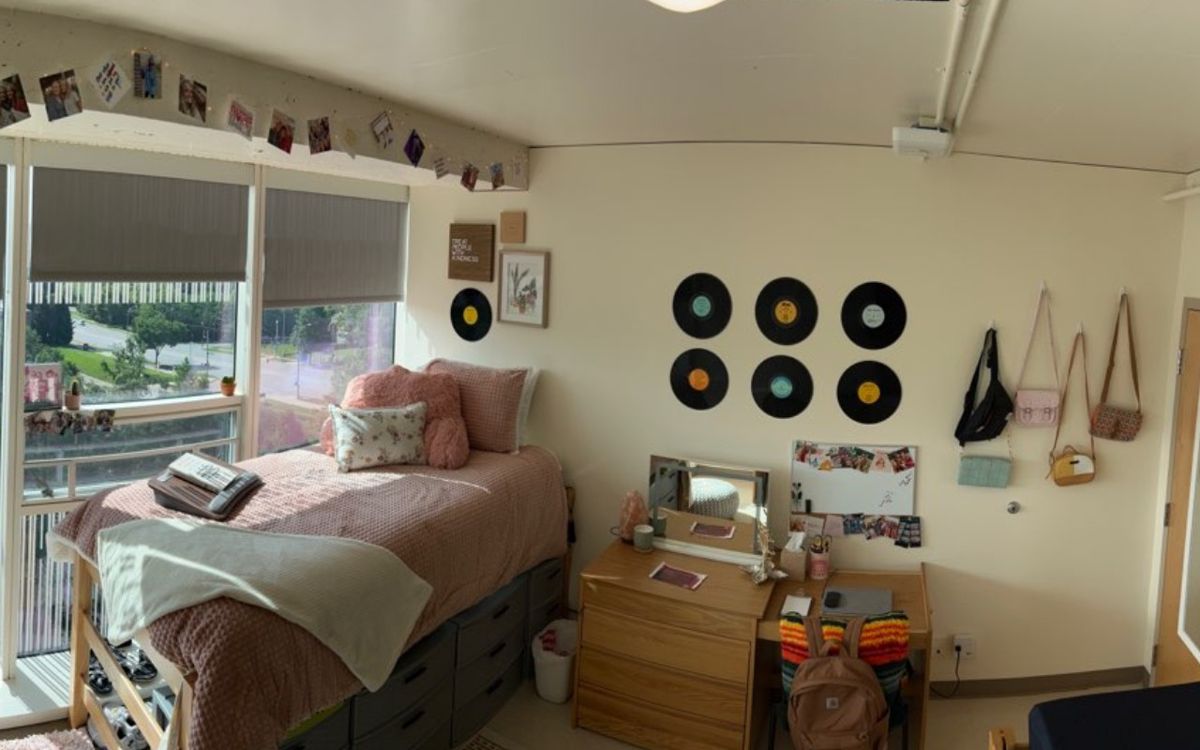
Newest residence hall with junior suite-style rooms for 328 residents. Home to Marian Spencer Scholars and Honors themed floor.
2911 Scioto Lane
Award-winning 13-story apartment-style twin towers with full kitchens and bathrooms. Popular with upperclassmen and living-learning communities.
2931 Scioto LaneTraditional-style residence halls in the West Campus neighborhood. Daniels is a 12-story building housing approximately 775 students.
45 West Daniels Street
Suite-style residence hall overlooking the Campus Green with community lounges on each floor
50 W Corry Blvd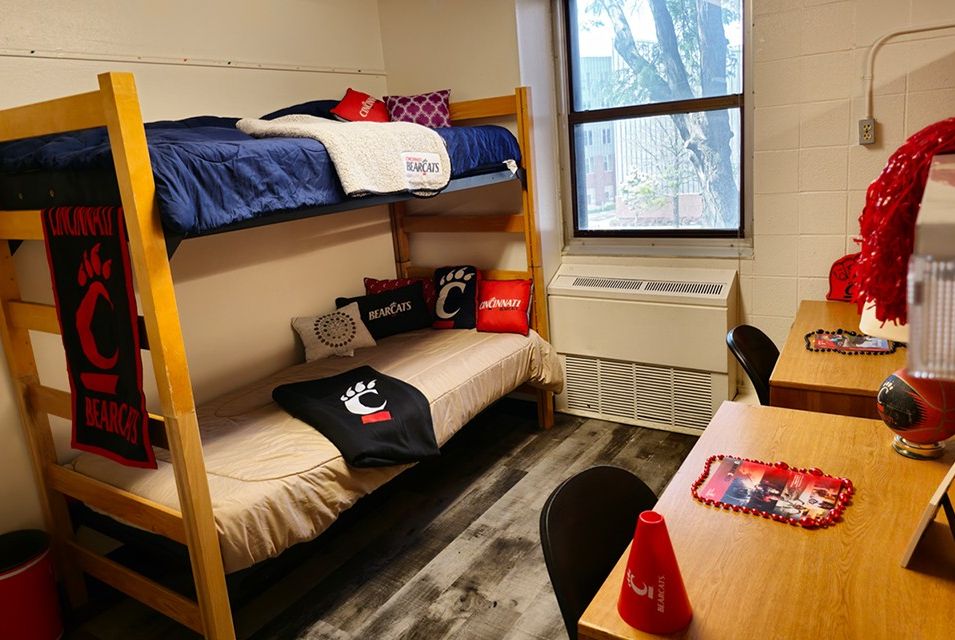
Traditional-style residence hall with double rooms and shared community spaces
2615 Commons WayShuttles, parking and accessible rides.
Free campus shuttle with 16 buses covering 13 routes connecting Uptown Campus to nearby neighborhoods and satellite campuses.
Cincinnati Metro public transit with free rides for UC students and employees.
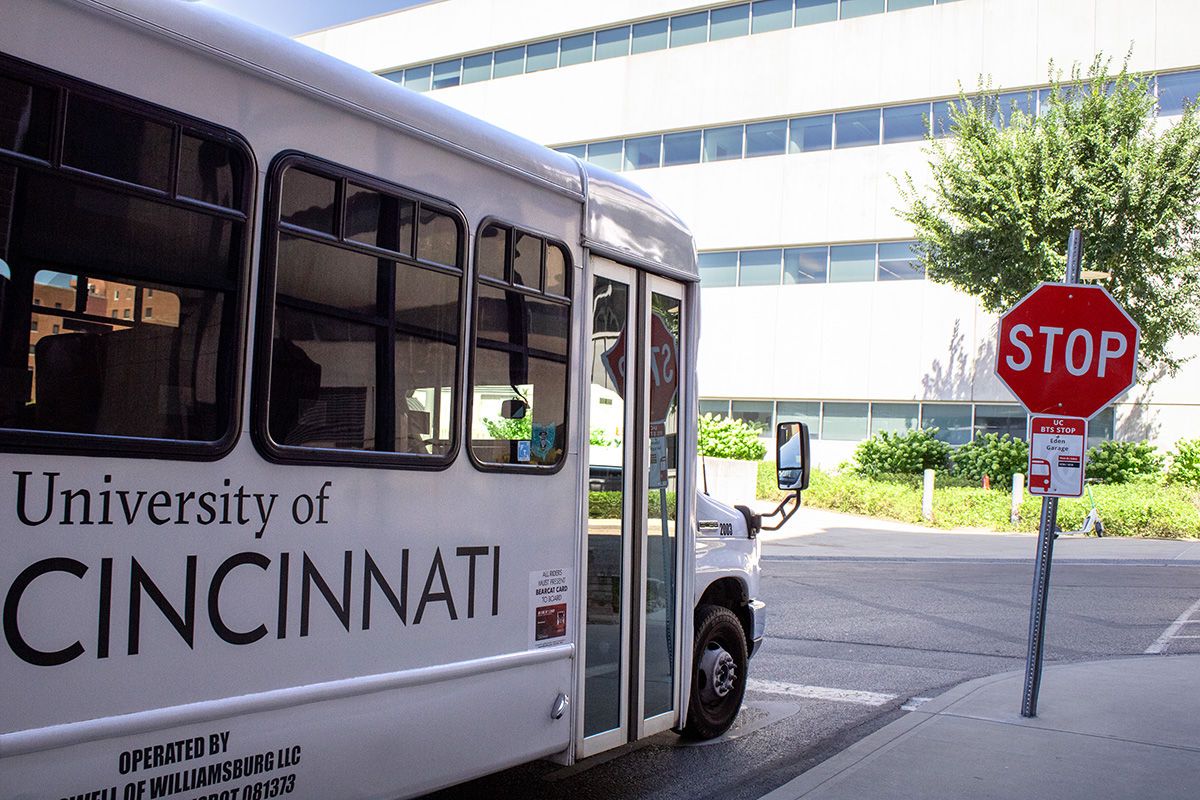
Free campus shuttle system with 12+ routes connecting campus, housing, and surrounding neighborhoods
Manages all campus parking including student permits, visitor parking, garages, and surface lots across the Uptown Campus.
51 Corry BoulevardPublic bike share system with stations on and near campus. Day passes and annual memberships available for short point-to-point trips.
Typical pay 4 years after graduating. Top 6 of 55 bachelor's majors with published pay.
Source: College Scorecard, field-of-study data.
5 things worth doing early
UC invented cooperative education in 1906, and in two of its colleges it is still the shape of the degree rather than an add-on. The College of Design, Architecture, Art, and Planning and the College of Engineering and Applied Science "mandate co-op for all undergraduate programs." How it actually runs: you alternate a semester of classes with a semester of paid, full-time work, 35+ hours a week for 15 to 18 weeks, and "typically, you'll complete between three and five co-op semesters prior to graduation, which is equivalent to 1.5 years of job experience." After the first year the calendar stops looking like a normal one — there is no long summer off, because a summer is often a work term. That is why these are five-year degrees. UC's own tuition guarantee policy describes the co-op track as "five years comprised of 15 consecutive semesters", against "four years comprised of 12 consecutive semesters" for everyone else. If you are comparing UC against a four-year offer elsewhere, compare five years of living costs, not four — and then compare the earnings from three to five paid work terms against them. While you are out on co-op you are still enrolled, and you still pay something: "Effective Fall 2026, the undergraduate co-op fee will increase from $465 to $600 per co-op term." It is deliberately small — "Students pay this reduced co-op fee—rather than full tuition—while on co-op in order to maintain full-time status for financial aid and insurance purposes." So budget $600 a work term, and know that your aid package and your insurance do not lapse while you are away.
The tuition number in the brochure is not the number on your bill, and the gap depends on which college you are in. For 2026-27 on the Uptown campus, an Ohio resident in the current cohort pays a base tuition of "$618" per credit hour, or "$7,412" for a full-time term. Then the program fee lands, per term: DAAP $750, the College-Conservatory of Music $750, Engineering & Applied Science $504, Business $500, Nursing (BSN) $338, and Arts & Sciences STEM disciplines $215. Non-STEM Arts & Sciences coursework is included in base tuition and adds nothing. Part-time students pay the same fees per credit hour instead — DAAP $63, CCM $75, Engineering $42, Business $42, Nursing $29, A&S STEM $18. Two things follow. First, switching majors can change what you pay, in both directions, and nobody will volunteer that when you switch. Second, when you compare UC's cost against another school's, compare base tuition plus your college's fee — a DAAP or CCM student pays $1,500 a year more than the headline figure, before any course-specific fees. Some individual course fees can be opted out of, on a form due by the fifteenth day of the term; program fees are not that, and cannot be opted out of.
Registration at UC is not first-come. You get an enrollment appointment, and everyone above you in the queue registers before your window opens. What decides the order is the one thing a first-year student has least of. The Registrar: "Priority is determined by the number of hours a student has earned and will include any transfer credit that has been awarded. It will not include hours for which the student is currently registered." Read that twice. The fifteen credits you are sitting in right now count for nothing until they are finished and posted. AP, CCP, IB and transfer credit already on your record do count, and they move you up immediately — which is a real argument for sending every score and every transcript in, even for credit that does not shorten your degree. One more rule worth knowing: "Early Registration Enrollment Appointments are assigned only to those students who have registered for UC classes within the last three semesters." Take a term off and you lose the early window. Find your own time in the Catalyst Student Portal under My Academics, then View Assigned Enrollment Time; UC also emails continuing students their day and time. Build your shopping cart before it opens, with a backup for every class, because the seat you wanted may already be gone by the time your window arrives.
Exam week gets built from a grid, not from your schedule, and it is perfectly possible to end up with three finals between breakfast and dinner. UC's exam schedule carries the remedy in one sentence: "Any student having three examinations on one day can request postponement or reassignment of one of them provided it can be worked out with the instructor of one of the courses in question." The conditions are worth reading carefully. It is three in a day, not two. It is a request, not an automatic right — the words are "provided it can be worked out". And it is settled with an instructor, one of the three, not with the registrar; appeals go to the University Registrar afterwards. So the move is to pull up the exam grid the week the schedule posts, not the week of exams, count your days, and if one of them has three, email the most flexible of the three instructors early, while moving you is still easy. Instructors are also expected to be ready to offer a make-up for a genuine conflict. Fall 2026 exam week runs December 7 through 11, after classes end December 5; final grades are due December 16 at 5:00 pm.
Gus is an AI college companion built around your actual course materials. Upload the textbook chapter, the slide deck, the reading, the syllabus — then ask. It answers out of those pages rather than out of the internet, so the answer matches the class you are actually in. From the same material it will tutor you through what has not clicked, generate flashcards and quizzes, summarize a lecture you recorded, and check your writing. It is free to try.
Your tuition rate is frozen the year you arrive
The Cincinnati Tuition Guarantee is cohort-based: "Tuition, fees and room and board charges approved by UC's Board of Trustees for that academic year are guaranteed to that academic year's entering degree–seeking student cohort." It covers "four years comprised of 12 consecutive semesters", or "five years comprised of 15 consecutive semesters" for cooperative education programs, and applies to every new undergraduate and new transfer student who first enrolled in Fall 2019 or later, at Uptown, the regional campuses and Cincinnati Online. Run past your window and you "will be assigned to the cohort that went into effect for the academic year immediately following the initially–assigned CTG cohort year", with guaranteed rates for up to three more semesters, repeating until you finish.
Bursar — Cincinnati Tuition GuaranteeBursar — student classifications under the guarantee12 to 18 credits cost the same; credit 19 does not
Full-time flat tuition covers "12 - 18 credit hours" for undergraduates. Anything above 18 is an overload and is billed per credit hour on top of the flat rate, at a rate that varies by college — UC's own worked examples use $459 and $501 per credit. There is no stated university-wide ceiling, but an overload is worth discussing with an academic adviser and Enrollment Services before you register, not after the bill.
One Stop — overload registration & chargesEvery UC student rides Metro free — after registering, every semester
Ride Free UC gives students, faculty and staff free access to all Metro fixed-route bus service across Greater Cincinnati, including travel between UC campuses, and Route 70 (the UC Connector) runs Uptown to Blue Ash weekdays 7 a.m. to 10 p.m. It is not automatic: download the Transit app, create the account with your UC email and enable EZfare ticketing, register for the pass with your UC 6+2 credentials, and select the term. "Students must register each semester", and activation can take "up to 5 business days" — so do it before the week you need it, not the morning you do. You board by tapping the QR ticket and showing your UC ID.
Parking & Transportation — UC Metro program (Ride Free UC)UC News — Ride Free UCDrop by day 14, withdraw after — and know which one you are doing
"Dropping a course typically occurs during the first 14 days of the semester and there is no grade recorded on your record, while withdrawing from the course typically occurs beginning day 15 of the semester and is reported as a 'W,' 'WX,' or 'WT' grade." For Fall 2026 the full-session drop deadline with a 100% refund was September 7; the withdrawal period ran to November 20. A W "will appear on the student's online grade report and on the transcript" but "has no impact on the GPA" — a WX is the version recorded when the instructor cannot verify your academic attendance. September 7 was also the last day to change credit hours or grading basis.
Registrar — withdrawal informationRegistrar — Fall 2026 dates and deadlinesAdvising holds, and the 50-mile housing rule
An Academic Advising Hold is placed when your major or your academic standing requires you to meet an adviser before you register, and it clears only after the appointment — which is a reason to book it well before your enrollment time, not the day of. On housing: unmarried first-year students under 21 who live outside a fifty-mile radius of the Uptown campus are required to live in University housing their first academic year. First-years inside fifty miles may live at their permanent address, but living anywhere else locally requires an approved Freshman Exemption Request.
Housing — requirements based on your proximityAdvising center directoryGus is not affiliated with, endorsed by, or sponsored by the University of Cincinnati. Tips checked against Cincinnati's own pages in September 2026. Campus info last updated September 2026. Stats from the U.S. Department of Education College Scorecard. Something out of date? hello@meetgus.app · All campus guides